Saturday, September 25, 2010

Pitru Paksha (पितृ पक्ष) ~ Shraaddh


Pitru Paksha also known as Mahalaya Paksha or Shraaddh Paksha or Kanagat, is a period of fifteen days dedicated to dead ancestors and forefathers. During Pitru Paksha, Hindus pay homage to their ancestors, especially through food offerings. This is an occasion to perform rites for the departed ancestors to keep their souls indebted for years.

Pitru Paksha Shraaddh begins on Ashwin Krishna Pratipada or first day of Ashwin month and goes up to the following New Moon (Amavasya) day as per North Indian calendar. Pitru Paksha is performed for the departed immediate relatives usually up to three preceding generations. In 2010 Pitru paksha starts on September 24 and ends on October 7th with Mahalaya Amavasya (Sarvapitru Amavasya).

Pitru Paksha is the occasion to repay debt to our departed ancestors by satisfying their souls by performing rites. For this purpose “Shraaddh” is performed with a belief that the dead ones would alive amongst us. Yama the Lord of death allows the souls to come down to the earth and receive offers from their descendants. This practice is made to the dead “Pitrus”. The last day of this period, the new moon day also called Sarvapitru Amavasya, is considered as the most important day in the year for performing obsequies and rites.

Legends related to Pitru Paksha

According to Hindu mythology, the souls of three preceding generations of one's ancestor reside in Pitru–loka, governed by Yama, who takes the soul of a dying man from earth to Pitru–loka. When a person of the next generation dies, the first generation shifts to heaven and unites with God, so Shraaddh offerings are not given. Thus, only the three generations in Pitru–loka are given Shraaddh rites, in which Yama plays a significant role.

When the legendary donor Karna died in the epic Mahabharata war, his soul transcended to heaven, where he was offered gold and jewels as food. Karna had done limitless charity of wealth, but had neglected to do Anna-Dana. Thus he found himself in the midst of wealth and plenty, but with no food to appease him. However, Karna needed real food to eat and asked lord Yama the reason for serving gold as food. Yama told Karna that he had donated gold all his life, but had never donated food to his ancestors in Shraaddh. Karna said that since he was unaware of his ancestors, he never donated anything in their memory. To make amends, Karna was permitted to return to earth for a fifteen day period, so that he could perform Shraaddh and donate food and water in their memory. This period is now known as Pitru Paksha.

The fifteen days of Mahalaya Paksha consists of 15 Tithi. They are Pratipat, Dvitiya, Tritiya, Chaturthi, Panchami, Shashti, Ashtami, Navami, Dasami, Ekadasi, Dvadasi, Trayodasi, Chaturdashi, Newmoon day (Sarvapitru Amavasya). According to Hindu mythology, every individual's who wants to perform this Pitru Tharpanam, they should do it on the same day of their ancestor died which will fall within any one of these fifteen days.

Importance of Pitru Paksha

The elder son or grandsons of the family performs Shraaddh in honor of the dead and offers respectful homage, during this period. It is believed that only after performance of Shraaddh ritual, the soul of the deceased relative attains Moksha. In this context, the scripture Garuda Purana says, "there is no salvation for a man without a son". The scriptures preach that a householder should propitiate ancestors, along with the gods, ghosts and guests. The scripture Markandeya Purana says that if the ancestors are content with the Shraaddh, they will bestow health, wealth, knowledge and longevity, and ultimately heaven and salvation upon the performer.

The performance of Sarvapitri Amavasya rites can also compensate a forgotten or neglected annual Shraaddh ceremony, which should ideally coincide with the death anniversary of the deceased. The ceremony is central to the concept of lineages. Shraddha involves oblations to three preceding generations—by reciting their names—as well as to the mythical lineage ancestor (Gotra). A person thus gets to know the names of six generations (three preceding generation, his own and two succeeding generations—his sons and grandsons) in his life, reaffirming lineage ties.

Even those who died without progeny received these oblations given on this Pitru Paksha Amavasya day. All those who had failed to do deeds of charity and Anna-Dana and were thus denied these comforts in the Pitru Loka, benefited by these ceremonies. Those deceased whose date of death is not known and whose annual Sraaddha cannot be done, they also get these oblations of Pitru Paksha. Souls whose life was cut off by violent, accidental or unnatural death and to whom, therefore, offerings cannot reach in the ordinary course, to them, too, the Pitru Paksha offerings reach directly.

Things not to do

During the period of Pitru Paksha, traditionally people do not buy or wear new clothes, and don't get a hair-cut. The day they perform the ritual, male members of the family do not even shave. Women do not wash their hair on that particular day. Auspicious works like marriage, settling marriage, any kind of birth ceremony etc. are prohibited during this period.

Here is the detailed calendar or schedule of Pitru Paksha 2010:• Pratipada Shraddh 2010 – 24 September
• Dwitiya Shraddh 2010 – 25 September
• Tritiya Shraddh – 26 September 2010
• Chaturthi Shraddh – 27 September 2010 – Bharani Mahalaya Shraddh
• Panchami Shraddh – 28 September 2010
• Sashti Shraddh – 29 September 2010
• Saptami Shraddh – 30 September 2010
• Ashtami Shraddh – 1 October 2010 – Madhvashtami or Arudrashtami
• Navami Shraddh – 2 October 2010 – Avidhava Navami or Avidhva Navami
• Dashami Shraddh – 3 October 2010
• Ekadashi Shraddh – 4 October 2010
• Dwadasi Shraddh – 5 October 2010 – Yateenam Mahalaya Shraddh or Yathi Dwadashi
• Trayodasi Shraddh – 6 October 2010 – Balbolaniteras
• Chaturdashi Shraddh – 6 October 2010 – Shraddh Chaturdashi or Ghat Chaturdasi
• Mahalaya Amavasya Shraddh – 7 October 2010

Om Tat Sat

Thursday, September 2, 2010

Gemstones ~Power, effects and uses of Gemstones


Gemstones ~Power, effects and uses of Gemstones

Gemology postulates that gems not only enhance fortune but also have therapeutic properties which can be used in the medical field. The inherent powers of Gemstones are recognized by modern science in the technological uses of crystals in watches, lasers, and computers but the more subtle potencies, such as their ability to promote physical healing in the body or their power to help balance human emotions, elude modern science. Gemstones are connected with the Planets & helps to maintain health, status, marital bliss, financial gains, professional success. According to Puranas and other authentic sources following kinds of Gems and jewels are prominent :
1) Manikya (Ruby).
2) Moti (Pearl).
3) Mungaa (Coral).
4) Panna (Emerald).
5) Pukhraj (Yellow Sapphire).
6) Neelam (Blue Sapphire).
7) Heera (Diamond).
8) Gomed (Hassonite).
9) Lahsumiya (Cat's eye).
10) Phiroza (Turquoise).
11) Chandrakant (Moon stone).
12) Ghrit Mani.
13) Tail Mani.
14) Bheeshmak.
15) Upalak Mani (Opal).
16) Sphatic Mani (Rock Crystal).
17) Paras Mani.
18) Ulook Mani.
19) Larvart (Lapis Mani)
20) Masar Mani.
21) Ishiv.

Legend of the Gemstones:
According to Vishnu Purana and Shrimad Bhagwat Mahapurana, Bali, the grandson of Prahlad was a great king of the demons. With a resolution of dethroning Indra as the king of heaven, Bali organized a hundred Ashwamedha Yagyas. On the appeal of Indra, Lord Vishnu decided to stop the hundredth Ashwamedha Yagya of Bali and arrived there in the guise of Vamana and begged him to donate land measuring three steps. In two steps, Lord measures entire earth and heaven. Since there was not room then to put the third step, Bali offered his head for the Lord to put his third step. Thus, Lord Vishnu sent Bali direct to the hell. But with the touch of the Lord's foot, Bali's body converted into gems and stones. According to another version of the lore, a fierce battle followed between Lord Vishnu and Bali. During the battle, Lord Vishnu broke Bali's body into pieces. Thus different pieces of Bali's body fell at different places and took the shape of gems and jewels. Thus, origin of different gems and jewels is as follows:

Ruby: It originated from the blood drops of Bali, hence it has red or pink colour.
Pearl: It is believed to have originated from the mind of Bali.
Coral: That part of Bali's blood which flowed down to the sea formed the coral.
Yellow Sapphire: It originated from the flesh of Bali.
Blue Sapphire: It originated from the eyes of the demon King Bali.
Diamond: It originated from the pieces of Bali's brain.
Hassonite: This gem originated from the fat of the demon king.
Cat's Eye: This jewel originated from the Yagyopavit (sacred thread) of Bali.
Turquoise: It originated from the nervous system of the demon king Bali.
Moonstone: It originated from the radiance of the eye's pupils.
Ghrit Mani: This jewel originated from the pieces of the waist.
Tail Mani: Skin of the king Bali formed this jewel.
Bheeshmak: This gem was produced from the head pieces of Bali.
Upalak Mani: Cough or phlegm of Bali produced this jewel.
Sphatik Mani (Rock Crystal): This jewel was formed from the sweat of Bali.
Paras Mani: Pieces of Bali's heart formed Paras Mani.
Ulook Mani: This jewel was formed from the pieces of Bali's tongue.
Lapis Lazuli: Bali's hair formed this jewel.
Masar Mani: This jewel was produced from the faeces of Bali.
Ishiv Mani: This jewel is believed to have from the semen of King Bali.

Thus in all, eighty four different parts and constituents of the demon king Bali. Of them, only twenty-one are described as Gems or Jewels due to peculiar brilliance they possess. Of these twenty-one gems, only nine are most famous for their radiance and are hence known as Navaratna. Thus, there are nine main gems or jewels, twelve common gems and sixty-three ordinary gems which are also known as sub-gems.

Why Gemstones are Prescribed :
Gemstones are prescribed to either strengthen or balance the energies of these planets in question, i.e. strengthen weak planets so that they do create some good effect, or further strengthen already strong planets, such that their effect is more pronounced. As an example, someone may want to strengthen Mercury to cure any speech impediment or skin inflammation, as a weak Mercury is known to cause these ailments. A person may want to strengthen Saturn if it is a Raj Yoga causing planet, in that case, in Saturn’s dasha or bhukti, the results given by Saturn multiply. Surely all good and bad effects multiply at the same time, there is a need for balance.

Gemstones should be worn strictly after consulting an astrologer because an Astrologer can only know which Gemstone is suitable and which is not according to your Rashi/Lagna/Ascendant and the position of the planet associated with the stone in your birth chart to get maximum benefits in life. It is necessary to purify the gemstone before wearing and the mantra associated with that Gemstone. When a Gemstone is worn it generates positive vibrations and powerful aura around the individual, which in turn protective and resists any untoward vibrations coming from external sources.

Power of gemstones :
The Gemstones selected for use should always be in contact with one’s body to absorb their healing properties. All stones or gems have magnetic powers in varying degrees, and many of them are beneficial to us for their therapeutic cures. They emit vibrations and frequencies which have strong potential influence on our whole being. They create strong energy fields which enable us to be charged with their energies. The Gemstones are used for healing, transforming, balancing, and attuning the body, mind and soul. They are a manifestation of vibrancy, light and color, life, textures, transparency and clarity. They activate our abilities, soothe and comfort, heal and balance through the purity of their rays. The patterns in the stones reveal to us the changes that keep taking place, indicating that life is change – that the process of evolution is a cosmic law. Each Gem, tuned to a particular ray, has a special role to play. The more precious stones that you wear, the more strongly will you be charged with cosmic forces, radiating out into your surroundings.

Gemstone therapy :
It is based on the theory that certain Gemstones possess specific healing energies. Physical and emotional problems can block the body's energy center, resulting in illness of some kind. When a Gemstone comes into contact with the body, its energy is released and transferred to the person. Use Gemstone therapy to unblock negative energy or heal the body and Gemstone meditation to heal the spirit.

Gemstones have an amazing capacity to absorb the cosmic vibes from the planets. Each precious stone has its own special energetic vibration from its magnetic field. Gemstones have been recognized since Ancient times. They were very much used in Ayurvedic medicine in the form of dust, or infusions or dipped in water. Due to this power they are considered as a part of the planets themselves. Almost every branch of astrology discusses gemstones as way to influence the impact of the planets on the native.

If you are interested in improving specific areas of your life, like health, finances, family, mental peace, etc., then feel free to contact us at anu0562@gmail.com

Gemstones Terminology- English/Hindi (Indian Name)

Sunday, August 29, 2010

PANCHANG ~ Vedic Hindu Calendar

PANCHANG ~ Vedic Hindu Calendar

Panchang is an ancient vedic science that helps in knowing when to synchronize your actions with good times to reduce obstacles and increase chances for success. “Panch” means five and “Ang” means parts in Sanskrit. A Panchang is made up of five parts based on the lunar calander. These are used for fixing Muhurthas and preparation of horoscopes and predictions by Astrologers.

Panchang of the day based on the calculations of time, latitude, longitude, planetary positions and timezone of your current place of living. It is consulted for finding and selecting an appropriate and auspicious time for important occasions, ceremonies or actions like marriage, education, travel, starting new business or project, examination, interview etc. The five parts of Panchang are described below :

(1) Tithi (lunar day)
(2) Nakshatra (constellation)
(3) Yoga (an auspicious moment)
(4) Karan (half of the part of Tithi)
(5) Vaar (day of the week)

(1) Thithi (lunar day) :

Tithi is the date according to the Hindu lunar calendar. The Hindu lunar calendar consists of a dark and a bright fortnight also called Krishna paksha and Shukla Paksha. Tithi is said to be complete when moon has 12 degree from the sun. when moon complete 12 degree each time one tithi is comptete. There are 30 tithis in a lunar month. There are several rituals and festivals associated with Tithis. Most of the festivals fall on the new moon day (amavsaya) or the full moon day (poornma). It is important to note that starting or ending of a Tithi depends upon the degree of Moon from that of Sun therefore a Tithi ends or starts at any time in a day not like the Modern Time when a date changes at midnight.

There are 30 tithis in a lunar month. In Indian Astrology, the calculation of the Tithis starts from Pratipada (The first day in each half of the lunar month) of the Shukla-Paksha. Tithis are as follows :
The Hindu Tithis are classified into 8 types:
Nanda Tithi – Bestows happiness, enjoyment.
Bhadra Tithi - Auspicious for stating new work
Jaya Tithi - Auspicious for winning over enemies.
Rikta Tithi – To be avoided for any important work.
Poorna Tithi – Auspicious to complete all jobs.
Dagdha Tithi--Inauspicious, fear of hurdles, obstructing the accomplishment of the work.
Visha Tithi--inauspicious, fear of hurdles, obstructing the accomplishment of the work.
Hutashan Tithi--inauspicious, fear of hurdles, obstructing the accomplishment of the work.
2. Nakshatra:

Nakshatra Literally means “that which does not decay.” A group of stars is called Nakshatra. The whole space has been divided into 27 parts and each part has been given the name of Nakshatra. There are twenty-seven Nakshatras considered in Vedic Astrology. Each one of them has thirteen degree and twenty minutes of the zodiac. Each Nakshatra has a planetary lord used for Vimsottari Dasa and K.P. calculations. Nakshatra can be known with help of degrees of Moon in a particular sign at the time of birth. They are as follows :
The Indian astrologers believe that the combination of the last 15 Ghati of 'Uttarashadha Nakshatra' and the first 4 Ghati of the Shravani Nakshatra i.e. 19 Ghatis in all, constitute the 'Abhijeet Nakshatra' and this particular Nakshatra is considered to be very auspicious to begin a good work.

PANCHAKA NAKSHATRA : The following group of five Nakshatras are considered as having five defects (Panchakadosha). They are Dhanistha, Shatabhisha, Purvabhadrapada, Uttarabhadrapada and Revati.

MOOLA NAKSHATRA : A child taking birth in this Nakshatra, which consists of Jyestha, Aashlesha, Revati, Mool, Magha and Ashwini Nakshatra are not considered as auspicious. Therefore, for the pacification of this 'Moola Nakshatra', some specific rites are performed 27th days after the birth when the same Nakshatra returns. Out of these six Nakshatras, which constitute Moola Nakshatra, Jyeshtha and Moola are called 'Gandant Moola' and Aashlesha is called as 'Sarpa Moola'.

ADHOMUKHA NAKSHATRA : As the name of this Nakshatra implies, works like digging a well, or lying a foundation is considered as auspicious. This particular Nakshatra is itself constituted by Nakshatras. They are: Moola, Aashlesha, Vishakha, Kritika, Purvaphalguni, Purvashadha, Purvabhadrapada, Bharani and Magha.

DAGDHA NAKSHATRA : For commencement of any work, these Nakshatras are considered as inauspicious. Therefore, commencing any work in this Nakshatra is prohibited if the days on which, this Nakshatra falls are as under-
Sunday - Bharani
Monday - Chitra
Tuesday - Uttarashadha
Wednesday - Dhanishtha
Thursday - Uttaraphalguni
Friday - Jyeshtha
Saturday – Revati

Nakshtra also indicate Yoni, Gana and Nadi of an individual.

Yoni: There are 14 Yonis (animal symbols) in Vedic astrology assigned to nakshtras are as follows :

Gana: There are 3 Ganas :
1. Deva: (Divine)
2. Manav: (Human)
3. Rakshas: (Demon)

Nakshatras assigned to each Ganas are as follows:
Nadi: There are 3 Nadis :
1. Adi: (Vata)
2. Madhya: (Pitta)
3. Antya: (Kapha or Shleshma)

Nakshatras assigned to each Nadi are as follows:
3. Yoga:

A Yoga is obtained from the sum of the Nirayna Longitude of the Moon and Sun and the sum is divided into 27 parts of 13°20' each. There are 27 yogas :
Ganda, Vyatipata, Atiganda, shoola are considered inauspicious yoga.

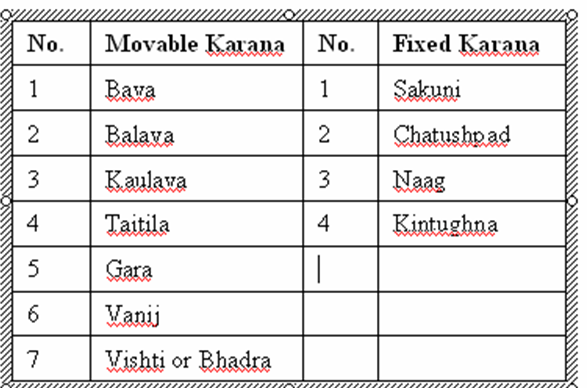
4. Karana:

Half of Tithi is called “Karana”. A Karana is completed when the Nirayana longitude of the Moon gains every 6° on that of Sun. There are 11 karanas in total. Four of them occur just once a month and are called the Fixed Karanas. The other seven are movable Karanas. They repeat 8 times starting from 2nd half of the first lunar day of a month.

Each of the Karana is said to have its own influence and interpretation. ‘Vishti’ is considered the most inauspicious karana. No important or new work is done during the period of this karana.

5. Vaar (day of the week) :

There are 7 days in a week. The days of the week along with the ruler planet are as follows :

The counting of days begins from the sunrise of the first day to the sunrise of the second day. In astrology, this system is known as 'AHORATRA', which means day and night taken together. Omitting the first letter 'A' and the last three letters 'T','R','A', the word 'HORA' is coined from which, the English word 'HOUR' originated. There are 24 HORAS in all.

GENTLE DAYS: Monday, Wednesday, Thursday and Friday are considered as the 'gentle' days. These days are considered auspicious for commencing any good work.

CRUEL DAYS: Tuesday, Sunday and Saturday are considered as 'cruel' days. Saturday is considered an auspicious day for undergoing operation. Thursday is considered auspicious for starting education. Wednesday is considered auspicious to start any business.

Om Tat Sat

Friday, August 27, 2010

Rahu Kaalam or Rahu Kaal


Rahu kaalam or Rahu Kaal is a certain amount of time every day that is considered inauspicious for any new venture according to Vedic astrology. In Hindu mythology, Rahu Kaalam is one of the eight segments of the day and considered inauspicious period in Indian astrology due to its associated with malefic Rahu . This period is ruled by Rahu. Rahu kaalam differs from place to place depending upon Sunrise and Sunset time. According to Vedic astrology a person should not undertake any new journey, work, job, interview, marriage, business dealing, sale or purchase of any assets. It will not give good results. Every day this Rahu kaalam lasts for around one and half hours (90 minutes) but the duration differs according to the length of the time between sunrise to sunset.

To calculate Rahu kaalam, the day duration from Sunrise to Sunset, at a particular location is divided into eight equal parts. There is no Rahu Kaalam during the first period of any weekday. On Sunday it falls on 8th period, Monday 2nd period, Saturday 3rd period, Friday 4th period, Wednesday 5th period, Thursday 6th period and Tuesday 7th period. Rahu kaalam and Yama Ghandam are the two time periods which are especially considered inauspicious for any new undertakings.

Rahu Kaalam Calculation
:
Example : Sunrise 6:00 a.m. Sunset 6:00 p.m. 1/8 of Day = 90 minutes


Vedic Panchang

Vedic Panchang for 28th August 2010 :
Maas~Bhadra,

Paksha~Krishna,
Weekday~Saturday,
Moon~Pisces,
Tithi~Chaturthi,
Nakshatra~Revati,
Yoga~Soola upto 10:47 then Ganda starts,
Karan~Bava upto 18:38,
Sun Rise 6:00:49

Wednesday, August 25, 2010

Planet and Nakshatra

Indian Nakshatras with equivalent Astronomical Name

Indian Nakshatras with equivalent Astronomical Name


Twenty Seven Nakshatras with their equivalent Astronomical Name